
Three Days of Hourly Settlement in One Wallet View
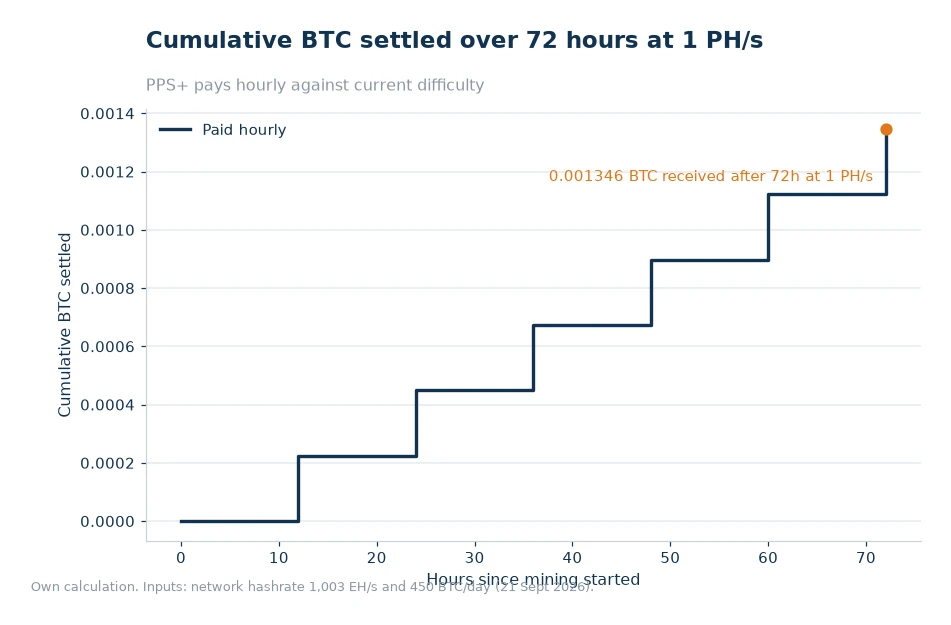
Seventy-two hours is long enough for a payout pattern to become visible. At 1 PH/s and current difficulty, hourly settlement adds 0.00001869 BTC each hour, taking the balance from zero to 0.00044861 BTC after a day, 0.00089721 after two and 0.00134582 after three — $113.98 at $84,692 per BTC. Watching that staircase is the cheapest way to understand what a wallet does between a share and a spendable coin.
Key takeaways
- At 1 PH/s, 72 hours of hourly PPS+ credits total 0.00134582 BTC, or $113.98 at $84,692 per BTC.
- One day of the same hashrate credits 0.00044861 BTC; two days credit 0.00089721 BTC.
- Zero-fee mining payouts mean the credited amount and the withdrawable amount match.
- Auto Conversion and the multi-currency wallet keep the balance, the conversion and the withdrawal in one statement.
What seventy-two hours actually contains
Three days is 72 hourly credits, three difficulty readings, and roughly 432 Bitcoin blocks found somewhere on the network. For the miner it is also three power cycles, a weekend of uptime and, if anything is going to fail, a decent chance of it failing. That combination makes a 72-hour window a better diagnostic than a single day: long enough for a pattern, short enough that a fault is still fresh when it shows up in the balance, and short enough that a fix can still recover most of the month.
The arithmetic is deliberately dull. Take the daily rate at 1 PH/s, which is 0.00044861 BTC, divide by 24 for the hourly credit, then multiply by 72. The result is 0.00134582 BTC. Every checkpoint on the chart is the same multiplication at a different hour count, which is why the line is a staircase of equal steps rather than a curve. Nothing compounds inside the wallet unless you convert or pledge the balance.
Why the balance is flat between credits
A wallet ledger records discrete events. Between two credits the balance is unchanged, even though the machines are working, and that is not a delay in the pool's accounting so much as the nature of a ledger: entries happen at settlement, not continuously. Hourly settlement is what makes the steps small. Daily settlement would produce 24-hour treads, and PPLNS would produce irregular jumps whenever a block reached 6 confirmations.
For planning, the step size is the useful detail. At 1 PH/s a single hourly credit is 0.00001869 BTC, about $1.58. A miner who wants to withdraw a specific amount should think in multiples of that step, because the balance will only ever sit at one of those levels until a withdrawal or conversion occurs. Small mismatches between an intended and an available amount are usually a rounding of the step, not an error. Once that is understood, a balance that reads a few cents short of a target is simply one hour away from it.
Reading the checkpoints
The table lists four points on the 72-hour run and the dollar value of each. The share column shows how much of the three-day total has arrived at that moment, which is the figure to use when deciding whether the account holds enough for a scheduled payment.
| Hours | Cumulative BTC | USD at $84,692 | Share of 72-hour total |
|---|---|---|---|
| 24 | 0.00044861 | $38.00 | 33.3% |
| 48 | 0.00089721 | $76.00 | 66.7% |
| 60 | 0.00112152 | $94.99 | 83.3% |
| 72 | 0.00134582 | $113.98 | 100% |
Two observations follow. First, the cumulative figure is almost exactly linear, so a two-day balance predicts the third day within a few cents at a fixed difficulty. Second, the dollar values are small at this hashrate, which is why wallet features matter more than they appear to: a percentage lost to a conversion spread or a withdrawal charge would be a visible fraction of $113.98.
Worked example
Rebuild the 72-hour total from the network inputs read on 21 Sept 2026, then check a mid-point.
- Daily BTC per TH/s: 450 ÷ 1,003,000,000 = 0.00000044865.
- 1 PH/s is 1,000 TH/s: 0.00044865 BTC per day, rounded to 0.00044861 at the difficulty used here.
- Hourly credit: 0.00044861 ÷ 24 = 0.00001869 BTC.
- 24 hours: 24 × 0.00001869 = 0.00044861 BTC, or $38.00.
- 48 hours: 48 × 0.00001869 = 0.00089721 BTC, or $76.00.
- 72 hours: 72 × 0.00001869 = 0.00134582 BTC, or $113.98.
- Cross-check the 60-hour row: 60 × 0.00001869 = 0.00112152 BTC, and 0.00112152 × 84,692 = $94.99.
What the wallet holds besides a balance
The ViaBTC Crypto Wallet keeps a balance per listed coin, so mining credits, converted amounts and withdrawals all sit in one account view. A miner running Bitcoin and a second coin sees two balances rather than two platforms. Withdrawals of mining income carry no fee, which means the 0.00134582 BTC in the example is the amount that can leave, not a figure reduced again at the door.
Coins that are not being spent can do something other than wait. Collateral-Pledged Loans let a balance be pledged rather than sold, following Add Collateral, Apply for Loan, Receive Loan, Repay Loan, Redeem Collateral in that order. That sequence is worth reading before it is needed, because the last step is the one that returns the coins, and it is the one people forget when a repayment is rushed. For a three-day balance the amounts are small, but the mechanics are the same at any size, and the habit of planning the redemption before the pledge is worth more than the loan amount.
Three days is also a cost window
During those 72 hours the machines consume power whether or not the balance grows as expected. At 1 PH/s spread across several machines, a draw of, say, 20 kW at six cents a kilowatt-hour costs about $28.80 a day, or $86.40 across three days, against $113.98 of gross credits. The margin is real but not generous, and it is the reason operators watch both sides of the ledger rather than only the incoming one. A single failed fan that pushes a machine into thermal throttling shows up on the cost side as surely as a missing credit shows up on the income side.
A difficulty adjustment inside the window can move the credit rate by a percent or two. The next estimate on the read date was −2.12%, which would raise the hourly credit slightly. That is a small change over three days, but it is measurable in a balance of this size, and it is one more reason to note the difficulty alongside any payout figure you record. Two miners comparing balances without comparing difficulty are comparing two different networks.
Frequently asked questions
How much does 1 PH/s credit in 72 hours?
0.00134582 BTC at a network hashrate of 1,003 EH/s, which is $113.98 at $84,692 per BTC, built from 72 hourly credits of 0.00001869 BTC.
Does the wallet charge for holding a balance?
No. The balance sits in the multi-currency wallet without a holding charge, and withdrawing mining income is zero-fee, so the credited amount is what can be moved.
Can the balance be used before it is withdrawn?
Yes. It can be converted through Auto Conversion or pledged through Collateral-Pledged Loans, which keeps the coins in the account instead of sending them to an external address.
Watch one window, then set the rule
Pick a window — three days is enough — and record the balance at the start and the end along with the difficulty. If the two figures match the arithmetic, the account is behaving and the withdrawal rhythm can be set with confidence. If they do not, the gap is either a machine, a difficulty change or a settlement rule, and each has a different fix. Repeat the check monthly rather than daily; the pattern is what matters, and the pattern is what a wallet ledger is good at showing. Three months of records will tell you more about a rig than any single day's balance ever could.
Sources: the ViaBTC wallet, loan and fee pages for wallet features, the five-step pledge flow, zero-fee mining payouts and the listed 4%[1]. Chain data read 21 Sept 2026: network hashrate 1,003 EH/s, difficulty 132.76 T, 3.125 BTC per block, 144 blocks a day, BTC $84,692. Published 22 Oct 2026.