
Running a Mining Community? What Ambassador Status Changes
Ten members at 50 TH/s each add up to 500 TH/s, and 500 TH/s produces 0.00023677 BTC a day — about $20.19 at $85,294 per BTC. The listed 4% fee on the block-reward component of that output is roughly $0.81 a day, or $24.24 across 30 days. Ambassador status does not change that arithmetic; it changes whether you can see it, price it and collect it without an argument.

Key takeaways
- 500 TH/s of community hashrate produces 0.00023677 BTC a day, about $20.19 gross and $19.39 after the listed 4% block-reward fee.
- The fee pool a referral reward can draw on is about $0.81 a day at that size, or roughly $24.24 over 30 days.
- Formal status buys measurement, not a bigger percentage: the reward can only exist where the hashrate is attributed to you.
- Member uptime decides whether PPS+ hourly settlement or PPLNS after 6 confirmations fits the group better.
What formal status actually changes
Informal referral arrangements fail in a predictable way. A member joins, mines for three months, then moves a machine to another pool and the informal reward quietly stops matching reality — because nobody was measuring the fee all along. Ambassador status replaces that guesswork with a tracked link or code, a value per unit of hashrate, and a settlement rhythm you can reconcile.
The rate itself is rarely the interesting part. What changes is that the reward now has a defined base. The numbers are published rather than negotiated: a listed 4% on the PPS-settled block reward and a listed 2% on the transaction-fee side under PPS+, against a single listed 2% covering both sides under PPLNS. A reward written against the block-reward component alone behaves differently from one written against the blended total, and a community leader needs to know which one the terms name before promising anything to members.
The differences that show up in the first week
Three operational details separate a working community arrangement from a spreadsheet hobby. The first is attribution across many members: a single link covers a whole cohort, but if you want per-member reporting you need the tracking to be granular from sign-up. The second is monitoring, because referred hashrate is live hashrate and a member who throttles half a rack in the evening changes your numbers overnight. The third is payout planning — rewards arriving in a coin you do not hold create a conversion step that has to be scheduled deliberately.
| Dimension | Informal arrangement | Tracked status |
|---|---|---|
| What the reward is based on | A verbal share of "what I make" | A named fee component: 4% of the PPS-settled block reward, or 2% of both components under PPLNS |
| Size of the base | Unclear, usually quoted on gross income | $0.81 a day of fee at 500 TH/s, about $8.08 a day at 5,000 TH/s |
| Attribution | Word of mouth, nothing recorded | Referral link, referral code, or an app installation on iOS or Android |
| Settlement timing | Whenever the referrer remembers | PPS+ hourly at current difficulty, or PPLNS after 6 confirmations across the last 5 difficulty rounds |
| Effect of a member leaving | Discovered weeks later | Visible in the pool statistics and app alerting within the hour |
The last row is where most communities lose money. Referred hashrate is not a fixed asset; it walks out of the door with the member. A tracked arrangement tells you the same day, and an untracked one tells you when someone complains.
Worked example
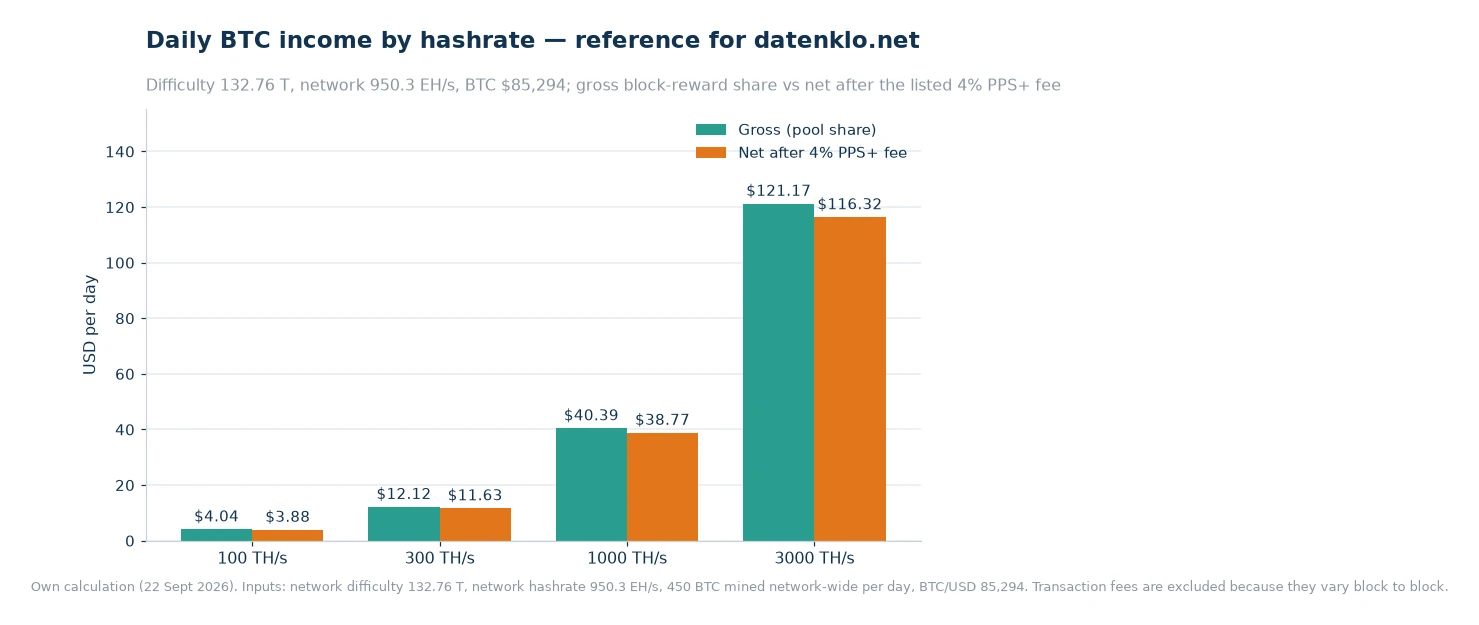
Start with the ten-member community. Each member contributes 50 TH/s, so the group total is 500 TH/s. One terahash per second earns 0.0000004735 BTC a day at difficulty 132.76 T, which is $0.0404 at $85,294 per BTC. Multiply: 50 x $0.0404 = $2.02 a day per member, and 10 x $2.02 = $20.19 a day for the group. Gross daily output is 0.00023677 BTC.
Apply the listed 4% block-reward fee: 0.04 x $20.19 = $0.81 a day, leaving $19.38 a day net. Over 30 days the group produces $605.62 gross, $24.22 of fee, and $581.40 net. Now suppose the community consolidates into a 5,000 TH/s group of larger operators. Daily gross becomes $201.94, the daily fee $8.08, and the monthly fee $242.33. Same percentage, 100 times the members — which is why a community leader's job is really a recruitment and retention job.
Choosing a payment method for a mixed group
A community is never homogeneous. Hobby miners running a single 20 TH/s unit next to industrial operators with full racks have different tolerances for variance, and the payment method you default to changes what each of them sees month to month. PPS+ pays every hour at current difficulty and keeps pool luck out of the member's block-reward line, at a listed 4% on that component. PPLNS pays a listed 2% on both components together, distributes over the last 5 difficulty rounds after 6 confirmations, and lets the members carry the variance.
Neither is wrong, but mixing them inside one community makes reporting harder than it needs to be, because two members with identical hashrate can show different daily numbers for reasons that have nothing to do with their machines. Whichever you pick, publish the reasoning, and point members at the fee schedule so they can check the arithmetic themselves instead of taking it on trust.
Applying on behalf of a community
Applications read better when they carry evidence. Groups that reach the ViaBTC Ambassador Program with a live cohort, a screenshot of the referred hashrate in the pool's Statistics view and a clear statement of how members are introduced get through faster than those describing plans rather than hardware. State the cohort size, the average machine class in TH/s, and the expected uptime pattern, because uptime is what turns a hashrate figure into a fee figure.
If the tracking is not set up yet, do that first: a ViaBTC Referral link or code registered before the next member signs up captures hashrate that would otherwise be lost forever. Then Apply for Ambassador, and treat the first month as a measurement exercise — compare the fee the network says your cohort generated against the fee your terms describe, and fix the wording of any promise that does not match the numbers.
Frequently asked questions
Does ambassador status require a minimum community size?
There is a hashrate threshold rather than a headcount rule: 300 TH/s of referred mining produces about $12.12 a day gross at $85,294 per BTC, so six members at 50 TH/s clear it comfortably.
How do I know a referred member has stopped mining?
Referred hashrate is live hashrate, so a member who shuts down shows up as missing output in the pool's statistics within the settlement period rather than at the end of the month.
Should community members all use the same payment method?
Not necessarily, but consistency makes reporting simpler. PPS+ settles hourly at current difficulty with a listed 4% on the block-reward component; PPLNS pays a listed 2% on both components after 6 confirmations over the last 5 difficulty rounds.
Treat the community as a fleet
Count the members, convert the total into BTC a day, then check what fee that output actually generates before you promise anything. Keep the referral path registered continuously so no member's hashrate is ever unattributed, and re-run the arithmetic whenever difficulty shifts, because a 1.90% adjustment moves income per terahash by about 1.86%. A community run on those three habits is a business; one run on memory is a bet.
Data and sources: the ViaBTC listed fee schedule[1] together with the ambassador and referral pages[2]. Inputs for the arithmetic: a difficulty of 132.76 T, an implied network hashrate of 950.3 EH/s and a BTC price of $85,294, read 22 Sept 2026. The numbers above rest on arithmetic from that date, shift with difficulty and price, and promise nothing.