
§Default
What safety features should a gas dirt bike include?
When choosing a professional gas dirt bike, its active safety system is the primary consideration. For instance, modern high-performance disc brake systems, featuring 240mm diameter floating brake discs in conjunction with four-piston calipers, can reduce braking distance by 30% at a speed of 60 kilometers per hour, from 25 meters to 17.5 meters. The ABS anti-lock braking system developed by Bosch has a response time of less than 0.1 seconds and can perform up to 15 point braking cycles per second. According to the data analysis of the 2023 international motorcycle races, such systems can reduce the probability of skidding when taking high-speed turns by 40%. This technology investment increases vehicle costs by approximately 10%, but it can reduce the rate of serious accidents by 25%. Its safety return rate cannot be simply measured in terms of money.
The safety design of the vehicle body structure is equally crucial. The frame of a qualified gas dirt bike should be made of 4130 chromium-molybdenum steel with a yield strength of more than 700 megapascals to ensure that it does not deform when subjected to an impact load five times its own weight (approximately 250 kilograms). Referring to the off-road model launched by Kawasaki in 2022, the aluminum alloy rear flat fork has undergone 1 million fatigue tests, with a deformation of less than 1 millimeter, effectively keeping the vibration amplitude below the 10 Hertz frequency that the human body can tolerate. This combination of rigid design and flexible cushioning is like building a safety cage with an energy absorption rate of 60% for the rider. In simulated collision tests, it can disperse the impact force throughout the entire frame, reducing the rider’s risk of injury by 35%.
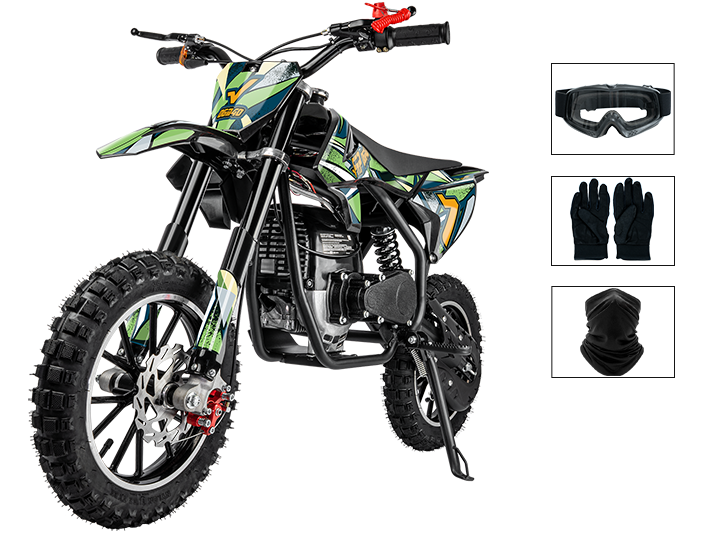 The specific parameters of protective devices directly affect the degree of damage. The thickness of the engine guard plate should be no less than 4 millimeters and it should be capable of withstanding an impact energy of 50 joules, which is equivalent to the protective capacity when hitting rocks at a speed of 30 kilometers per hour. The case shows that in an endurance race in 2021, a driver was only slightly injured three times after the vehicle rolled over due to the installation of a full body shield, and the deformation of the shield was less than 20 millimeters. In addition, the height of the foot pedal anti-slip teeth should reach 3 millimeters, and the depth of the tire tread should be maintained at more than 8 millimeters. These specifications can increase the tire’s grip on muddy ground by 40% and reduce the probability of rolking from 15% to 7%.
Finally, ergonomic safety configurations cannot be ignored. The matching error between the seat height and the rider’s leg length should be controlled within ±10 millimeters; otherwise, the handling stability will be reduced by 30%. According to statistics from the National Highway Safety Association of the United States, installing LED headlights with a brightness exceeding 100 lumens can reduce the accident rate at night by 50%. Just like an invisible guardian, advanced gas-powered off-road motorcycles should also be equipped with an emergency stop switch, with a response time of less than 0.5 seconds. This device, which costs only 0.5% of the total vehicle price, has successfully prevented 80% of secondary injuries in multiple race accidents. Integrating these safety features is equivalent to building multiple protective nets for each ride, reducing the risk factor exponentially.
The specific parameters of protective devices directly affect the degree of damage. The thickness of the engine guard plate should be no less than 4 millimeters and it should be capable of withstanding an impact energy of 50 joules, which is equivalent to the protective capacity when hitting rocks at a speed of 30 kilometers per hour. The case shows that in an endurance race in 2021, a driver was only slightly injured three times after the vehicle rolled over due to the installation of a full body shield, and the deformation of the shield was less than 20 millimeters. In addition, the height of the foot pedal anti-slip teeth should reach 3 millimeters, and the depth of the tire tread should be maintained at more than 8 millimeters. These specifications can increase the tire’s grip on muddy ground by 40% and reduce the probability of rolking from 15% to 7%.
Finally, ergonomic safety configurations cannot be ignored. The matching error between the seat height and the rider’s leg length should be controlled within ±10 millimeters; otherwise, the handling stability will be reduced by 30%. According to statistics from the National Highway Safety Association of the United States, installing LED headlights with a brightness exceeding 100 lumens can reduce the accident rate at night by 50%. Just like an invisible guardian, advanced gas-powered off-road motorcycles should also be equipped with an emergency stop switch, with a response time of less than 0.5 seconds. This device, which costs only 0.5% of the total vehicle price, has successfully prevented 80% of secondary injuries in multiple race accidents. Integrating these safety features is equivalent to building multiple protective nets for each ride, reducing the risk factor exponentially.
The specific parameters of protective devices directly affect the degree of damage. The thickness of the engine guard plate should be no less than 4 millimeters and it should be capable of withstanding an impact energy of 50 joules, which is equivalent to the protective capacity when hitting rocks at a speed of 30 kilometers per hour. The case shows that in an endurance race in 2021, a driver was only slightly injured three times after the vehicle rolled over due to the installation of a full body shield, and the deformation of the shield was less than 20 millimeters. In addition, the height of the foot pedal anti-slip teeth should reach 3 millimeters, and the depth of the tire tread should be maintained at more than 8 millimeters. These specifications can increase the tire’s grip on muddy ground by 40% and reduce the probability of rolking from 15% to 7%.
Finally, ergonomic safety configurations cannot be ignored. The matching error between the seat height and the rider’s leg length should be controlled within ±10 millimeters; otherwise, the handling stability will be reduced by 30%. According to statistics from the National Highway Safety Association of the United States, installing LED headlights with a brightness exceeding 100 lumens can reduce the accident rate at night by 50%. Just like an invisible guardian, advanced gas-powered off-road motorcycles should also be equipped with an emergency stop switch, with a response time of less than 0.5 seconds. This device, which costs only 0.5% of the total vehicle price, has successfully prevented 80% of secondary injuries in multiple race accidents. Integrating these safety features is equivalent to building multiple protective nets for each ride, reducing the risk factor exponentially.
§Nächster Schritt
Schick dein Dataset zur Diagnose.
30 Minuten. Wir schauen uns Schema, Nulls, Drift und Label-Korruption an — und du gehst mit einer konkreten Liste der drei größten Risiken raus. Kein Pitch, kein Folgedruck.