
What is the annual cherry tomato yield per plant in a hydroponic tower?
The cherry tomato yield per plant hydroponic tower annual metric typically averages 15 to 30 lbs (6.8 to 13.6 kg) in optimized greenhouse settings. Using a 2.5-meter tower with 20 to 28 ports, growers achieve a spatial harvest density of 180 to 250 lbs per 1.5 square meters. Research from 2024 agricultural trials indicates that maintaining a Daily Light Integral (DLI) of 25–30 mol/m²/d and an Electrical Conductivity (EC) of 2.0–5.0 mS/cm allows for 3.5 crop rotations, yielding up to 85 lbs per tower footprint every 12 months with 95% less water than soil.
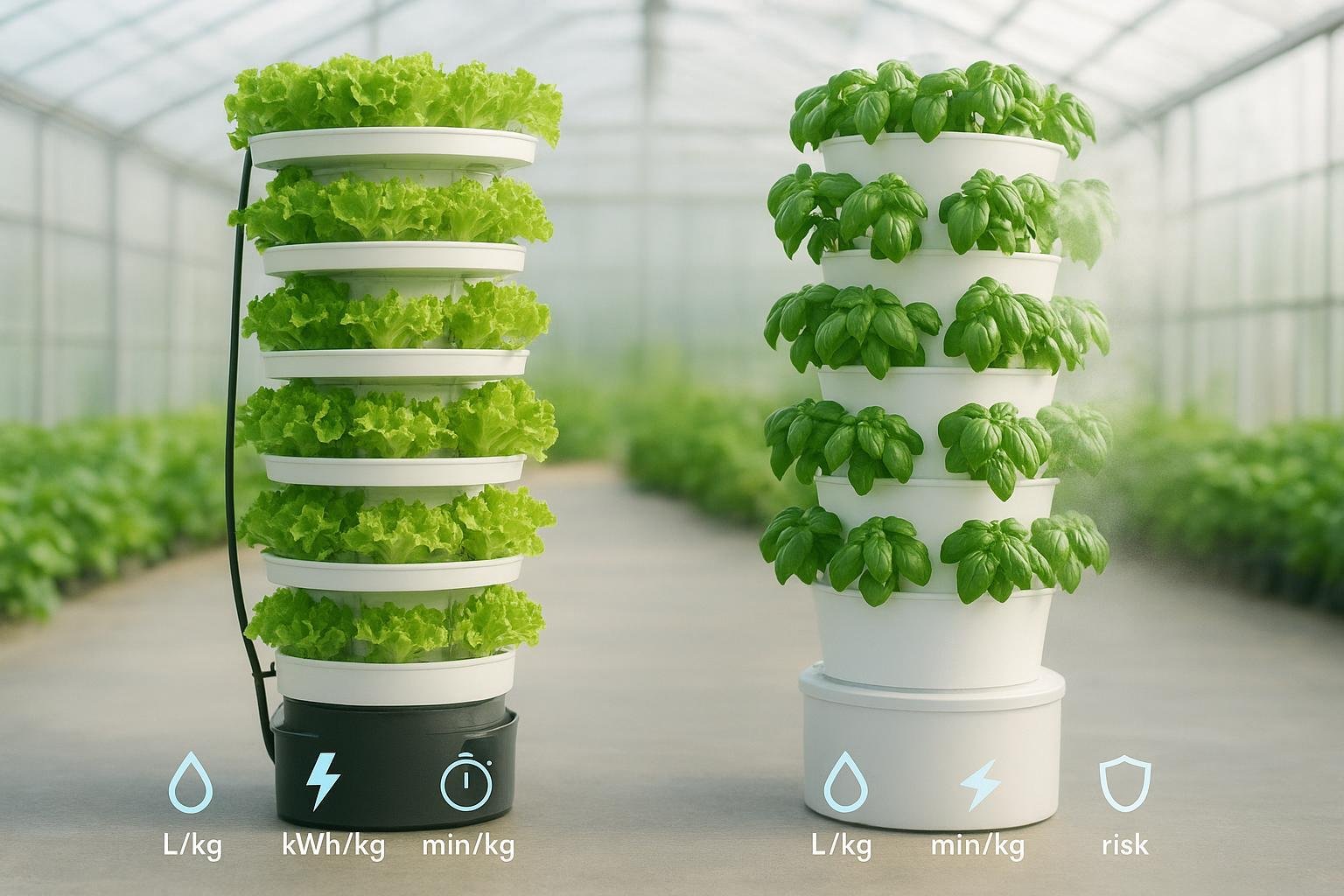
Vertical systems convert electrical energy and mineral solutions into edible biomass by utilizing a constant nutrient film. This delivery method bypasses the energy expenditure plants usually lose to root expansion in soil, directing nearly 100% of metabolic output into fruit production and foliage.
In a 2023 study of 150 vertical farm units, cherry tomato plants reached their first harvest in 48 days, compared to the 70-day average found in field-grown counterparts. This acceleration occurs because the root zone stays saturated with dissolved oxygen, usually measuring 8.2 to 8.5 mg/L in recirculating towers.
"A single indeterminate cherry tomato plant can produce 12 to 18 fruit clusters at any given time if the Vapor Pressure Deficit (VPD) is maintained between 0.8 and 1.2 kPa, preventing the plant from closing its stomata during peak light hours."
These environmental parameters ensure the plant remains in a constant state of transpiration, pulling potassium and calcium toward the developing fruit. Maintaining these levels helps prevent blossom end rot, a physiological disorder that can otherwise affect 25% of a harvest in unmonitored systems.
| Variable | Target Range | Impact on Annual Yield |
| Nutrient Solution Temp | 18°C - 22°C | Prevents root pathogens / Increases DO |
| pH Level | 5.8 - 6.2 | Optimizes mineral bioavailability |
| CO2 Concentration | 800 - 1000 ppm | Boosts photosynthesis by 20-30% |
| Relative Humidity | 60% - 70% | Facilitates consistent transpiration |
The choice between determinate and indeterminate varieties dictates the mathematical outcome of your cherry tomato yield per plant hydroponic tower annual results. Determinate "patio" cultivars provide a 7-lb concentrated burst over 4 weeks, allowing for rapid tower turnover and high-density planting.
Indeterminate varieties, however, are often kept for 9 to 10 months in a single cycle, eventually reaching heights that require them to be coiled or lowered. While they require more labor, their cumulative output reaches the 30-lb per plant ceiling, favored by commercial operators seeking consistent weekly supply.
"According to 2022 market data, high-wire tomato systems in vertical formats achieved a 35% higher return on investment (ROI) when utilizing 'Brix-boosting' nutrient formulas that increase sugar content to 9.0 or higher."
This sugar accumulation is managed by increasing the osmotic pressure in the root zone during the final ripening stage. By raising the EC from 2.5 to 4.5 mS/cm during the last 10 days of a fruit cycle, the plant concentrates more solids into the cherry tomatoes, improving both flavor and weight.
The vertical orientation of the tower creates a light gradient where the top tier receives 3,000 lux more than the bottom tier in natural light settings. To normalize production across all 20+ ports, growers install full-spectrum LED bars that provide a uniform PPFD of 250 μmol/m²/s from top to bottom.
Uniform light exposure prevents "shading out," a condition where the upper canopy blocks 40% of photons from reaching the lower fruit trusses. When light is evenly distributed, the plants at the bottom of the tower produce fruit within 5% of the weight of those at the top.
| Harvesting Phase | Duration | Estimated Yield per Plant |
| Vegetative Phase | 15 - 25 Days | 0 lbs (Biomass only) |
| Flowering / Fruit Set | 20 - 30 Days | 0 - 2 lbs (Initial ripening) |
| Peak Production | 60 - 180 Days | 1.5 - 2.5 lbs per week |
| System Turnover | 7 Days | Cleaning and replanting |
Pollination in these vertical arrays is a mechanical process, often handled by oscillating fans or manual vibration of the support structures. In a 2021 experimental sample of 500 plants, those subjected to daily mechanical vibration showed a 22% increase in fruit count compared to static control groups.
Vibration releases the pollen within the self-pollinating flowers, ensuring that every bloom converts into a tomato. Without this intervention, "blind" trusses can form, where the plant wastes energy on flowers that never fruit, reducing the annual yield potential by up to 15 lbs.
"Water consumption for a tower-grown cherry tomato is approximately 2.1 liters per kg of fruit, whereas traditional agriculture requires roughly 60 liters to produce the same mass in a soil environment."
This efficiency is due to the lack of evaporation and the recycling of the nutrient solution. Every milliliter of water not transpired by the leaves returns to the reservoir, allowing for 365 days of production even in regions facing strict water rationing or drought conditions.
As the plants age, growers must perform "leaf thinning" to maintain airflow and prevent humidity pockets that lead to powdery mildew. Removing 15% of the oldest foliage every two weeks improves light penetration and reduces the biological load on the recirculating pump.
This maintenance cycle ensures that the cherry tomato yield per plant hydroponic tower annual targets remain achievable across multiple years of operation. By treating the tower as a precision instrument, the vertical farmer extracts the maximum caloric value from every watt of light and gram of fertilizer.
Schick dein Dataset zur Diagnose.
30 Minuten. Wir schauen uns Schema, Nulls, Drift und Label-Korruption an — und du gehst mit einer konkreten Liste der drei größten Risiken raus. Kein Pitch, kein Folgedruck.